- Home
- Foot & Ankle Conditions
- Less Common Conditions
- Osteochondral Lesion (Talar Dome Cartilage Damage)
Ankle Conditions: Talar Dome Cartilage Damage (Osteochondral Lesion)
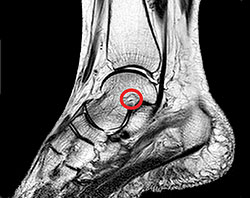
The talus bone is commonly referred to as your ankle bone, sitting at the base of your tibia (shin bone) and fibula (calf bone). It helps support the weight of your leg during activities like walking and allows your foot an upward and downward range of motion.
However, unlike most bones, no muscles attach to the talus; its position depends on the neighboring bones. The talar dome has three parts: the talus head, body, and neck. The top of the talar dome, the talus body, is covered completely by cartilage, giving it a rounded dome shape.
Any part of the talar dome can be damaged alongside other ankle injuries, and our doctors will often check each part to try to diagnose your ankle pain. One such injury is chondral damage, sometimes called a talar dome lesion or osteochondral defect (OCD).
It occurs when damage is done to the articular cartilage on top of the talus dome and the subchondral bone beneath.
- Previous
- Condition
What causes a talar dome lesion?
Osteochondral lesions of the talus (OLTs) most commonly happen due to a traumatic injury like an ankle sprain, in which the foot and ankle joint are twisted or compressed. In some cases, the bones in the ankle joint hit each other, damaging the surface of the overlying cartilage and causing an osteochondral fracture.
If the cartilage heals improperly, blood flow to the underlying bone can be interrupted, resulting in osteochondritis dissecans (OCD), where the bone and cartilage begin to break off and remain floating in the ankle. This can cause chronic pain and ankle weakness.
However, other causes of osteochondral lesions of the talar dome include:
- Avascular necrosis (poor blood supply to the bone results in bone death)
- Repetitive motion and stress on the joint

What are talar dome lesion symptoms?
In most cases, talar dome injury symptoms will set in after the symptoms of the initial ankle injury have subsided. Symptoms will vary depending on where the injury occurs (medial, posterior, or anterior side of the dome).
Patients with talar dome lesions may experience:
- Pain that resolves after the initial trauma but then returns
- Pain that worsens with activity
- Swelling, ankle instability, and locking of the ankle joint
- The feeling that the ankle joint clicks or catches
Diagnosing osteochondral lesion of the talus
At University Foot & Ankle Institute, our orthopedic surgeons will begin by asking you about your medical history, such as if you have had any recent ankle fractures or sprains. They’ll also perform a physical exam, feeling and moving your ankle to test your range of motion and pinpoint the injured area.
UFAI clinics also contain X-ray, CT scan, and MRI machines. X-rays allow us to view the bones of the ankle joint, while MRIs and CT scans show us the soft tissue, including the ligaments, tendons, and cartilage.
Many times, talar dome lesions can be identified visually.
What are the treatment options for talar dome lesions?
The University Foot & Ankle Institute is one of the world's top foot and ankle centers. Our doctors and surgeons are recognized for providing treatment of large osteochondral lesions of the talus with removal or cartilage transplant.
However, when possible, we will try to use a non-surgical approach first.
Non-surgical treatments for talar dome lesions
For mild cases of talar dome lesions, in which there are no floating pieces of bone or cartilage, our doctors may recommend the following:
- Immobilization of the ankle joint with a non-weight-bearing boot or cast.
- Physical therapy to restore range of motion once the lesion has healed.
- Nonsteroidal anti-inflammatory drugs (NSAIDs) to help with inflammation and pain.
Surgical talar dome lesion treatment
Talar dome lesions are classified into stages using the Berndt and Harty classification system, ranking injuries from stage I to stage IV. Depending on the extent of the cartilage damage, treatment options can include arthroscopic removal of the damaged cartilage and drilling of the damaged region.
After arthroscopic debridement, in which our doctors clean up the joint by removing debris and freeing up any impingement, they will perform arthroscopic bone marrow stimulation. During this minimally invasive surgical technique, our doctors surgically cause microfractures to the anterolateral and mid-lateral areas of the talus. These openings allow blood and bone marrow into the damaged tissues, prompting new cartilage (fibrocartilage) to develop.
However, if the lesion is large or involves the deep bone below the cartilage-damaged area, another type of surgical treatment might be necessary. Our ankle surgeons may perform a transplant of fresh bone and cartilage. The bone can be taken from the patient's own body, usually in the form of a tibial autograft. Or, it may come from a lab, referred to as an allograft.
Autologous grafts using tissue from your own body typically have lower risks of complications as there’s next-to-no risk of your body rejecting its own tissue.
We implant the bone graft into the injured region, replacing the problematic areas and encouraging healing. The incidence of bone grafting is considerably lower than arthroscopy clean-out and bone marrow stimulation, as it is reserved for only the most severe cases.
BioCartilage transplant for osteochondral lesion treatment
BioCartilage is a revolutionary product that results in a stronger ankle joint, faster recovery, and reduced chance of re-injury than with traditional methods. Read more about BioCartilage.
What to expect after talar dome osteochondral lesion surgery
Because the talus bone lacks a strong blood supply, healing a broken talus can take longer than most bones, with talar dome lesion surgery recovery often taking months.
Patients recovering from talar dome osteochondral lesion treatment may not be able to walk without crutches for several weeks, after which they will likely wear a walking cast or ankle brace for several more months.
During gradual rehabilitation, we’ll recommend pain management medications and gentle exercises, usually through physical therapy, to help you regain your ankle strength, stability, and range of motion. Following our podiatrists' advice during the entire healing process is imperative, as doing too much too soon can reinjure the area or delay healing.
UFAI doctors have experience with talar dome lesions
The University Foot and Ankle Institute podiatry experts have decades of combined experience treating all forms of ankle injuries and concerns. Our orthopaedic surgeons use the latest technologies available to successfully diagnose and treat talar dome lesions in the most minimally invasive way possible. New patients or individuals concerned about foot or toe pain in the greater Los Angeles area are encouraged to call or schedule a consultation.
For a consultation, please call (877) 736-6001 or make an appointment online now.
University Foot and Ankle Institute is conveniently located throughout Southern California and the Los Angeles area. Our foot and ankle surgeons are available at locations in or near Santa Monica, Beverly Hills, West Los Angeles, Sherman Oaks, the San Fernando Valley, El Segundo, the South Bay, LAX, Calabasas, Agoura Hills, Westlake Village, Valencia, Santa Clarita, and Santa Barbara.

Osteochondral Lesion FAQs
What is a talar dome fracture?
A talar dome fracture is sometimes used interchangeably with the term talar dome lesion. However, a lesion refers to the tearing or fracturing of the talar dome. In contrast, a talar dome fracture is generally used to describe the condition when a piece of the cartilage breaks off of the talar dome.
Does a talar dome lesion need surgery?
If a talar dome injury is caught early enough, non-surgical treatment may be able to alleviate symptoms and allow the area to heal. However, talar dome lesion surgery is often needed if pieces of the cartilage have broken off and migrated into the joint or conservative treatment has failed to manage symptoms.
Will a talar dome lesion go away on its own?
Typically, talar dome injuries will not go away independently without intervention. Immobilization and rest may allow minor cases to heal. At the same time, other talar dome lesions may need to be surgically cleaned out, micro-fractured to encourage healing, or bone grafted.
-
Foot and Ankle Surgeon at University Foot and Ankle Institute

Dr. Abimbola Johnson completed his undergraduate degree at Loyola University Chicago, where he played Division II rugby and was also involved in social justice clubs aimed at helping younger students prepare for college.
Upon graduation, he entered Scholl College of Podiatric Medicine, where he served as president of the practice management club and volunteered as coordinator at the Free Foot Clinic in Chicago. He served his residency at Regions Hospital/Health Partners in St. Paul.
Dr. Johnson provides comprehensive medical and surgical care for a wide spectrum of foot and ankle conditions, including common and complex disorders and injuries. The doctor is uniquely qualified to detect the early stages of disease that exhibit warning signs in the lower extremities, such as diabetes, arthritis, and cardiovascular disease.
Dr. Johnson can be seen at our Santa Barbara location

 Great doctor's, I loved Dr. Franson. Great office staff too!Lori M.
 Great experience. Great communication. Great direction for my care. Very happy I chose to go with this particular doctor and o...Christopher R.
- Great service and care. Highly recommend Dr. Franson.David B.
- If you have to go see a Doctor than this is a great experience.Frank M.
- My doctor was great. Really greatRudolph B.
- Good.David E.
- Well as going over various options.Isabel C.
- Your Santa Barbara office and Dr. Johnson always give me excellent care!Jayne A.
- Dr. Jafary Is a Excellent surgeon, Extremely knowledgeable friendly polite and very courteous to his patients. He is a pleasure...Chris S.
- Dr. Gina Nalbadian was amazing!! I came in with an emergency foot situation and she had wonderful bedside manner and resolved m...Danielle C.
- I was frustrated that after 3 weeks I still hadn’t heard back about my PT referral status. And I did sit in a room for over 30 ...Sarah C.
- I’m very pleased with Dr. Kelman.Alan S.


-
 Listen Now
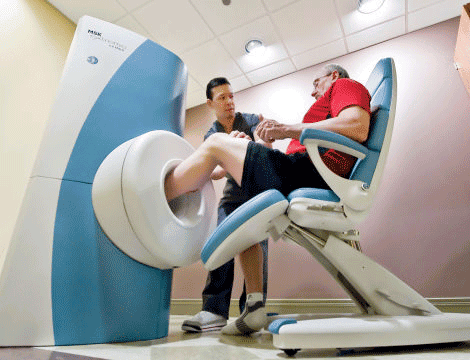
Revolutionizing Extremity Imaging: UFAI's Open MRI for the Foot and Ankle
Read More
Listen Now
Revolutionizing Extremity Imaging: UFAI's Open MRI for the Foot and Ankle
Read More
-
 Listen Now
Custom Orthotics vs. Over-the-Counter Inserts: Which Are Best for Your Feet?
Read More
Listen Now
Custom Orthotics vs. Over-the-Counter Inserts: Which Are Best for Your Feet?
Read More
-
 StimRouter: A Revolutionary Approach to Targeted Pain Relief
Read More
StimRouter: A Revolutionary Approach to Targeted Pain Relief
Read More
-
 Listen Now
An Inside Look at Shockwave Therapy for Heel Pain, now available in Valencia, CA
Read More
Listen Now
An Inside Look at Shockwave Therapy for Heel Pain, now available in Valencia, CA
Read More
-
 Listen Now
The Power of Pediatric Flexible Flatfoot Procedures
Read More
Listen Now
The Power of Pediatric Flexible Flatfoot Procedures
Read More
-
 Listen Now
Revealing the Secrets of Men's and Women's Shoe Sizes: Why Are They Different?
Read More
Listen Now
Revealing the Secrets of Men's and Women's Shoe Sizes: Why Are They Different?
Read More
-
 Listen Now
If the Shoe Fits, Wear it… Especially for Kids Shoes!
Read More
Listen Now
If the Shoe Fits, Wear it… Especially for Kids Shoes!
Read More
-
 Listen Now
How to Choose Running Shoes: 6 Essential Steps
Read More
Listen Now
How to Choose Running Shoes: 6 Essential Steps
Read More
-
 Listen Now
Is Barefoot Running Better? Or are you Running Toward Injury?
Read More
Listen Now
Is Barefoot Running Better? Or are you Running Toward Injury?
Read More
-
 Listen Now
The Link Between Foot Health and Posture
Read More
Listen Now
The Link Between Foot Health and Posture
Read More
-
 Listen Now
Why Are My Feet Different Sizes? It's More Common Than You Think
Read More
Listen Now
Why Are My Feet Different Sizes? It's More Common Than You Think
Read More
-
 Listen Now
9 Running Tips from Sports Medicine Experts
Read More
Listen Now
9 Running Tips from Sports Medicine Experts
Read More
-
 Listen Now
15 Summer Foot Care Tips to Put Your Best Feet Forward
Read More
Listen Now
15 Summer Foot Care Tips to Put Your Best Feet Forward
Read More
-
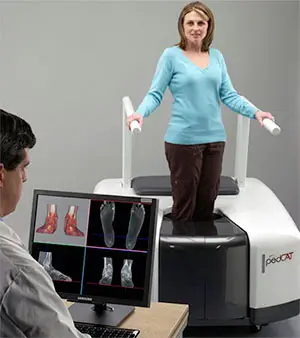 State-of-the-Art CT Scanning, Now in Our Office
Read More
State-of-the-Art CT Scanning, Now in Our Office
Read More
-
 Listen Now
Common Foot Problems In Aging Feet: What To Watch Out For
Read More
Listen Now
Common Foot Problems In Aging Feet: What To Watch Out For
Read More














