- Home
- Foot & Ankle Conditions
- Diabetic Foot Conditions
Diabetic Foot Conditions
Why do diabetics have foot problems?
For diabetics, ordinary foot problems can quickly lead to infection and serious complications.
High blood sugar caused by poorly controlled diabetes can cause nerve damage (neuropathy) —especially to nerve cells in the feet. When nerves are damaged, they don’t accurately report pain to the brain.
Pain is our body's alarm system, letting us know that something needs attention. Without this vital sensory feedback, you might overlook a minor injury like a cut, blister, or sore. If left untreated, these small problems can become serious.
Diabetes can also cause peripheral vascular disease (PVD)—poor circulation in the arms and legs (and hands and feet).
Poor circulation makes it harder for sores and cuts to heal. An infection or cut that won't heal due to poor blood flow puts you at risk of developing ulcers or gangrene. In extreme cases of infection, amputation of part or all of the foot may be necessary.
Neuropathy and PVD can cause more complex foot problems in diabetic patients.
Diabetic foot ulcers
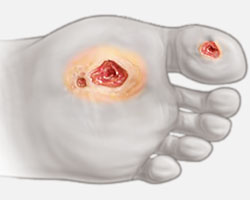
About 15% of diabetic patients experience foot ulcers (open sores on the feet), making them the most common diabetic foot complication. With neuropathy (nerve damage), small injuries don’t cause pain and can go unnoticed.
Untreated blisters and sores on the feet can provide an opening for bacteria and consequent infection. When these go untreated for significant periods of time, gangrene (tissue death) can occur. Severe cases can require amputation of all or part of the foot.
Treatment options for diabetic foot ulcers include noninvasive remedies designed to eliminate the pressure and friction that cause the ulcer. Doctors also use stem cell therapy to harness the body’s own healing power to heal foot ulcers.
As a last resort, surgical intervention is available for the resolution of otherwise intractable diabetic foot ulcers. Learn more about wound care here.
Diabetic foot osteomyelitis
An untreated infected foot ulcer can develop into osteomyelitis—a bone infection. Because neuropathy and PVD make foot ulcers harder to feel, the infection can progress unnoticed.
Osteomyelitis is often responsive to a course of antibiotic treatment. When antibiotics are ineffective, surgical removal of the affected portions of the foot may be required.
Charcot foot syndrome
Sometimes, diabetic neuropathy and peripheral vascular disease can cause softening of your foot bones, making them more vulnerable to fracture. The resulting bone disintegration can severely deform the foot. Although rare, this condition is one of the most serious that can confront diabetics.
The most effective treatment for Charcot foot syndrome is to prevent it before it occurs. Diabetics should carefully inspect their feet for cuts or injuries each and every day.
Nonsurgical care for diabetic Charcot foot includes eliminating any weight-bearing and wearing a protective splint, walking brace, or orthotic. Severe cases of Charcot's foot require the installation of hardware (plates and screws) to restore appropriate foot structure.
Cellulitis
Cellulitis is a bacterial infection of the skin and soft tissues. Diabetes may not be a direct cause of cellulitis, however, it can increase your risk of developing the condition. This is because a weakened immune system from diabetes increases your general risk of infection.
Cellulitis of the foot in diabetic patients can quickly escalate if not caught early. With diabetic neuropathy, foot injuries can go unnoticed due to a lack of pain sensation. Unnoticed injuries can easily become infected, and a weakened diabetic immune system allows that infection to spread quickly.
How to care for diabetic feet
Diabetic neuropathy and PVD interrupt the nerve signals to the brain. This means that diabetics often suffer foot damage without noticing. Constant vigilance and good foot care are the answer.
Check your feet every day for anything unusual. Look for cuts, redness, swelling, sores, blisters, or any other alteration in the foot.
Make sure to check every part of the foot, including between the toes. Use a mirror or ask for help if you have trouble bending over to see your feet.
Keep a close eye for warm spots, warts, and athlete's foot. A "hot spot" can be an early sign that a blister or ulcer is forming. Cover any existing blisters, sores, or cuts with a bandage to keep it clean.
Here are some tips for healthy feet:
- Wash your feet every day in warm (not hot) water. Dry your feet completely and apply lotion to the top and bottom to prevent dry skin. Dry, cracked skin is vulnerable to infection.
- Use talc between the toes to keep them dry and avoid fungal infection.
- Never go barefoot. Always wear shoes, even indoors, and make sure that there are no objects inside your shoes and that the shoe’s lining is smooth. Always wear socks with your shoes.
- Make sure your shoes fit perfectly. Get fitted for new shoes towards the end of the day when your feet have expanded.
- Special shoes can help if you suffer from bunions, hammertoe, or other foot deformities. Talk with our diabetic foot doctors about diabetic shoes and custom orthotic inserts.
- Trim your toenails straight across and gently smooth any sharp edges. This will help prevent ingrown toenails. If you struggle to reach your toes, talk to your podiatrist about having your toenails professionally trimmed.
- Get expert help from your diabetes care team in dealing with corns and calluses, and don’t use over-the-counter products to remove them. You may be able to gently smooth corns and calluses with a pumice stone.
- Have diabetic foot exams with your podiatrist on a regular basis.
- Keep the blood flowing. Elevate your feet when you’re sitting and flex your feet and wiggle your toes for a few minutes several times throughout the day.
- Give your feet some exercise by walking, riding a bike, or swimming.
- Don’t smoke (this is good advice in any context).
- Work with your healthcare team to keep your diabetes under control.
When should you see a doctor about your diabetic foot problems?
If you have type 1 or type 2 diabetes you should already be seeing a doctor regularly. However, if you notice any of the following changes or new symptoms you should seek medical attention:
- Changes in skin color of the foot
- Swelling in the foot or ankle
- Temperature change in the foot
- New pain or tingling in the feet or lower legs
- Athlete's foot or another fungal infection
- Signs of infection
- A new cut or blister
Why choose University Foot and Ankle Institute for diabetic foot care?
If you’re experiencing problems with diabetic feet or any other foot issues, we’re here to help.
Our nationally recognized foot and ankle specialists understand the special circumstances involved with treating the feet of diabetics.
They have decades of combined experience treating diabetic foot conditions including Charcot foot, diabetic neuropathy, ulcers, and infections. The physicians at University Foot and Ankle Institute podiatry clinic offer state-of-the-art diabetic care, helping to reduce complications and improving long-term foot health.
For more information or to schedule a consultation, please call (877) 736-6001 or make an appointment online now.
University Foot & Ankle Institute is conveniently located throughout Southern California and the Los Angeles area, as diabetic foot doctors near me are available at locations in or near Santa Monica (on Wilshire Blvd.), Beverly Hills, West Los Angeles, Manhattan Beach, Santa Barbara, Westlake Village, and Valencia California, to name a few.

Diabetic foot FAQs
What does a diabetic foot ulcer look like?
- Usually located on the bottom of the foot, often under the big toe or on the ball of the foot.
- The ulcer might appear red, with the skin around it often being warm and swollen.
- The edges of the wound can be irregular, and the depth of the ulcer varies.
- The skin around the ulcer may be calloused or discolored, indicating pressure points or areas of irritation.
- There might be signs of infection, such as pus, an unpleasant odor, or the wound may be oozing.
What does diabetic foot pain feel like?
Common descriptions of this pain include:
- Tingling or Burning Sensation: Many people describe a tingling or "pins and needles" sensation in their feet. This can also feel like a burning or hot sensation.
- Sharp Pains or Cramps: Some experience sharp, jabbing, or shooting pain. These pains can be quite severe and may come and go.
- Increased Sensitivity: There may be heightened sensitivity to touch, making the weight of a blanket or even light touches painful.
- Numbness or Weakness: Over time, there can be a loss of sensation in the feet. This numbness can make it difficult to feel temperature changes or pain, leading to a higher risk of unnoticed injuries.
- Muscle Weakness: In more advanced cases, the muscles of the feet might weaken, affecting gait and balance.
- Nighttime Discomfort: Many people report that symptoms get worse at night, affecting sleep.
-
Foot and Ankle Surgeon and Director of University Foot and Ankle Institute

Dr. Bob Baravaria DPM, FACFAS is a Board-Certified Podiatric Foot and Ankle Specialist. He is an assistant clinical professor at the UCLA School of Medicine and serves as Director of University Foot and Ankle Institute.
Dr. Baravarian has been involved in athletics his entire life and played competitive tennis in high school and college. He has an interest in sports medicine, arthritis therapy, and trauma/reconstructive surgery of the foot and ankle. He is also fluent in five languages (English, French, Spanish, Farsi, and Hebrew),

Diabetic foot condition articles from our blog
- Common Foot Problems In Aging Feet: What To Watch Out For
- Neuropathy and Nerve Compression: Causes, Symptoms and Treatment
- Diabetic Foot Conditions: Charcot Foot
- Diabetic Foot Conditions: Osteomyelitis
- Why Diabetic Foot Exams Are Critically Important
- Do Your Burning Feet or Numb Toes Need to See a Doctor? Here's How to Know
- 6 Beach Bummers for Your Feet
 The care and treatment were first class. They entire staff is professional, knowledgeable, and takes great care of their patie...Douglas W.
 Great experience. Great communication. Great direction for my care. Very happy I chose to go with this particular doctor and o...Christopher R.
- Great service and care. Highly recommend Dr. Franson.David B.
 University Foot and Ankle Institute is an excellent comprehensive facility. Dr. Briskin is a wonderful Doctor and the staff is ...Lisa K.
- If you have to go see a Doctor than this is a great experience.Frank M.
- My doctor was great. Really greatRudolph B.
- Good.David E.
- Your Santa Barbara office and Dr. Johnson always give me excellent care!Jayne A.
- Dr. Gina Nalbadian was amazing!! I came in with an emergency foot situation and she had wonderful bedside manner and resolved m...Danielle C.
- I had a bad break on my 5th metatarsol when I was out of state. I called Dr. Franson's office as soon as I came back home. The...Glenna W.
- I was frustrated that after 3 weeks I still hadn’t heard back about my PT referral status. And I did sit in a room for over 30 ...Sarah C.
- I’m very pleased with Dr. Kelman.Alan S.



-
 Listen Now
Diabetic Foot Conditions: Charcot Foot
Read More
Listen Now
Diabetic Foot Conditions: Charcot Foot
Read More
-
 Listen Now
Diabetic Foot Conditions: Osteomyelitis
Read More
Listen Now
Diabetic Foot Conditions: Osteomyelitis
Read More
-
 Listen Now
Do Your Burning Feet or Numb Toes Need to See a Doctor? Here's How to Know
Read More
Listen Now
Do Your Burning Feet or Numb Toes Need to See a Doctor? Here's How to Know
Read More
-
 Listen Now
Neuropathy and Nerve Compression: Causes, Symptoms and Treatment
Read More
Listen Now
Neuropathy and Nerve Compression: Causes, Symptoms and Treatment
Read More
-
 Listen Now
Why Diabetic Foot Exams Are Critically Important
Read More
Listen Now
Why Diabetic Foot Exams Are Critically Important
Read More
-
 Listen Now
6 Beach Bummers for Your Feet
Read More
Listen Now
6 Beach Bummers for Your Feet
Read More
-
 Listen Now
Common Foot Problems In Aging Feet: What To Watch Out For
Read More
Listen Now
Common Foot Problems In Aging Feet: What To Watch Out For
Read More






